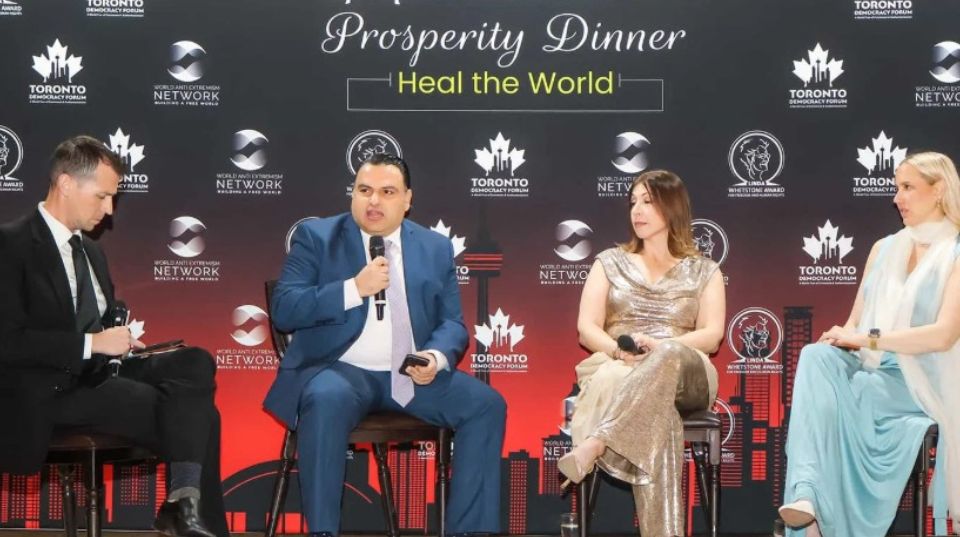
On November 16–17, Dr. Patrick Mardini, CEO of LIMS, spoke at the Toronto Democracy Forum, hosted by the World Anti-Extremism Network at the University of Toronto, on a panel examining “Building Resilient Societies for a Freer World: Freedom, Democracy, and Countering Oppression.”Dr. Mardini argued that the events of October 7, 2023, marked a decisive break in the region’s trajectory. Until then, the Gulf Cooperation Council (GCC) was edging towards normalisation with Israel, with Saudi Arabia at the center of attention, while the so-called Axis of Resistance, including Iran, Syria, Hezbollah, the Houthis and Hamas, opposed that process through military means. Two years of conflict that followed significantly weakened the axis, creating an opening for a renewed and potentially broader normalisation process that could extend beyond the GCC to Syria and Lebanon.
As the region turns to reconstruction, notably in Gaza, southern Lebanon and Syria, economic considerations have moved to the forefront. Yet progress has been slowed by growing reluctance to channel funds into closed, opaque and state-dominated economies, where resources are vulnerable to capture and leakage. Such systems are often prone to corruption that diverts funds from productive use, while leaving high youth unemployment and limited economic opportunity intact. The result is a climate of despair, in which weak institutions fail to deliver, and extremist groups move in to fill the vacuum.
By contrast, economic liberalisation gives citizens a stake in stability. The ability to own property, invest freely, trade across borders and operate without arbitrary political interference reduces corruption and strengthens public trust. Economic freedom, Dr. Mardini noted, is essential for long-term investment and peace, particularly by generating jobs for young people, the region’s most vulnerable demographic, limiting corruption, and reducing dependence on political actors.
This logic underpins LIMS’ work in Lebanon and Syria, where it advocates dismantling government monopolies, promoting competitive tenders, and advancing pro-market monetary, fiscal and trade policies. A dynamic private sector, Dr. Mardini argued, creates alternatives to political patronage, weakens the economic power of sectarian groups, and supports a more stable social order by widening access to opportunity.
The broader lesson from the region, he concluded, is that over-centralised government and weak institutions are not merely economic failures but national security risks. Open markets and competition are therefore central pillars of sustainable peace and prosperity.
The Middle East Reordering and the Case for a Free-Market Solution
11:14 | 30 November 2025