

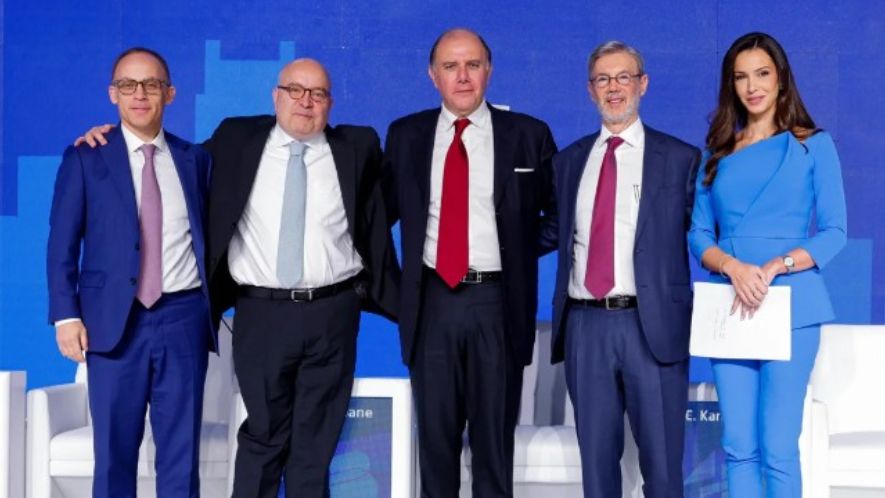
In November, the Lebanese government hosted Beirut One, a two-day investment conference, bringing together international investors and Arab government officials. One of the conference’s more closely watched discussions was titled “Reconnecting Lebanon with Global Capital”. It featured the newly appointed central bank governor, Karim Souaid, alongside international investors discussing the case for a currency board in Lebanon.
Ray Debbane, prominent investor on the panel, argued that Lebanon’s best chance of achieving durable currency stability rests in adopting a currency board. Conventional pegs and managed regimes, he said, ultimately unravel because central banks retain the power to print money or to finance government deficits. A currency board, by contrast, operates under strict rules: every unit of domestic currency must be fully backed by foreign reserves. New money can be issued only when fresh dollars enter the system. Such a framework could resolve the distortions created by Lebanon’s partial dollarization and allow foreign capital to return, once banks are restructured. Higher interest rates on Lebanese-pound without exchange-rate risk, would attract deposits and enable banks to resume lending to the real economy.
John Greenwood, a member of the Hong Kong Monetary Authority, pointed to Hong Kong’s experience in October 1983 to illustrate how a currency board can rapidly restore confidence in Lebanese banks. Once the currency board was introduced in Hong Kong, money that had fled during the crisis flowed back within weeks, interest rates fell and monetary conditions eased. The same mechanism, Greenwood argued, would revive Lebanon’s banking sector, draw deposits back into the system and jump-start financial intermediation.
Hong Kong’s model, he noted, was adopted despite widespread scepticism at the time, including opposition from academics, bankers, government officials and the IMF. Yet the framework proved resilient. It survived the political turmoil of 1989, the Asian financial crisis of 1997–98, the SARS outbreak in 2003, the global financial crisis of 2008–09 and, more recently, the Covid pandemic. Throughout these shocks, the exchange rate held, inflation remained contained and economic growth continued.
For Greenwood, the currency board explains how Hong Kong evolved into Asia’s prominent financial centre. He believes Lebanon, a small and open economy like Hong Kong, could achieve similar results. A currency board, he argues, would restore trust in the banking system, reverse capital flight, and help Lebanon reclaim its role as a regional financial centre on a more durable and sustainable footing.
- Is a Currency Board the Solution to Saving the Lebanese Pound? A Global Expert Lays Out the Case, November 18, 2025: Beirut I Conference, Panel Discussion (EN)